Is civility still attainable in the era of Trump? Four Michigan governors think it’s possible
https://michiganadvance.com/
America is not that far down the path of political ruin, and a return to normalcy in politics is possible, but citizens and the media need to change the way they …
America is not that far down the path of political ruin, and a return to normalcy in politics is possible, but citizens and the media need to change the way they speak to each other and consume news media in order to get there.
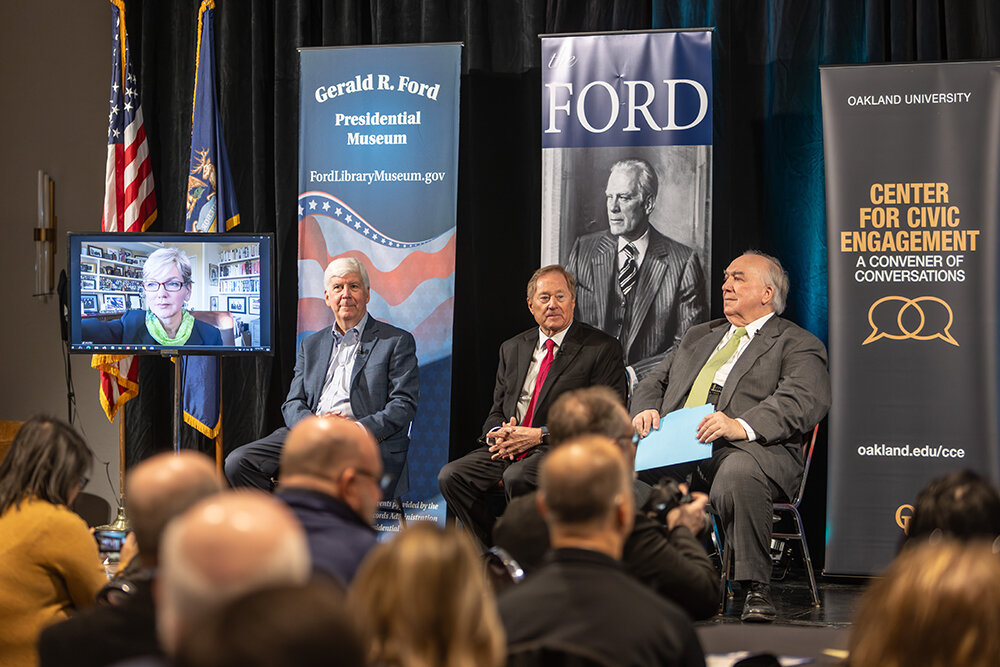
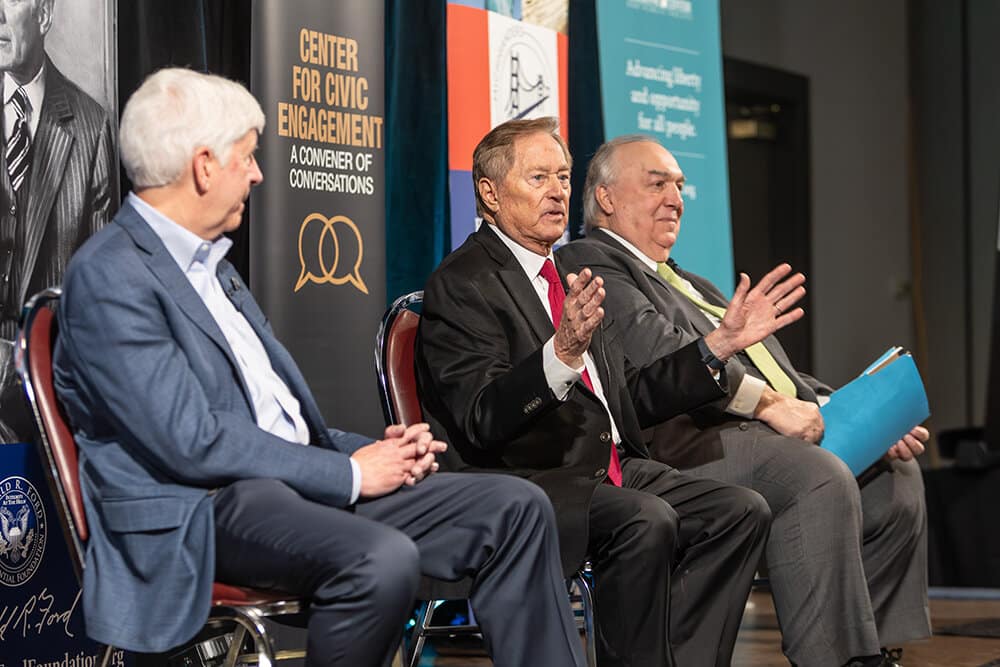
That was the prevailing message from a forum held Wednesday in Lansing, featuring four former Michigan governors — Rick Snyder, Jennifer Granholm, John Engler and Jim Blanchard — speaking on the subject of civility in politics. It was hosted by the Michiganders for Civic Reliance, Oakland University Center for Civic Engagement, Democracy Defense Project, Mackinac Center for Public Policy and the Gerald R. Ford Presidential Foundation.
It was also a soft launch for the new Michigan Civility Coalition, which plans to continue holding events to fight back against new waves of political animosity in the public discourse.
The very notion of altruistic civility may be hard to conceive during the age of President Donald Trump, whose brash and abusive approach to political messaging has changed the game forever. The advent of social media and polarized national news hasn’t helped but the former chief executives of Michigan said that too can be alleviated by focusing on local news instead of the alternate reality created by larger outlets and cable news.
Still, the event had its critics, some noting that civility from an old guard lens would neither help in dealing with Trump and his most loyal political acolytes, nor would it immediately repair some of the damage he’s done to civility in politics writ large.
In that way, Granholm, a Democrat, said the goal for the governors was not to ignore what was going on at the federal level and down to the grassroots political fields, where civility has all but died on the vine.
The 47th governor, who joined the event virtually, said the rules of engagement have changed because extremism is more interesting and gets a greater number of clicks.
“Efforts like this should be part of the rules that everybody engages in, conversations that are focused on civility,” Granholm said. “What I will say is, what I hope groups don’t come away from this effort is that we’re in denial. We’re not sort of civility-washing the actions of a president who, for many, is not any of those values, does not demonstrate the values that we talk about, like presuming good, or showing respect, or leading with humanity and communicating truthfully.”
Snyder said that politics has become more about winning the game than making policy that uplifts people in a positive way, and that was one of the major sins of the new political landscape in the third decade of the 21st Century.
“Ask yourself this question? The way you see behavior in politics, would it be acceptable in any other part of your life?” Snyder said. “Would it be acceptable in the workplace? Would it be acceptable as your family? And I believe we can’t control what everyone else does, but we can control ourselves. … Politics has become an absolute win-lose sport.”
Snyder, a Republican and Michigan’s 48th governor, said the danger in that thinking is that win-win environments in politics foster compromise and courtesy, and most of all, relationship building.
Blanchard, a Democrat and the state’s 45th governor, was asked about acrimony being the moneymaker for those bad actors and the deepening divide. He said it was the same as when he was running for his seat in the U.S. House of Representatives, which he held during the late 1970s before becoming governor in 1983 — the press loves a good fight and boring discourse was unremarkable.
Blanchard said outlets like Fox News have created an alternate universe for its viewers.
“I don’t know how you regulate the internet or social media. I wish I knew, but we talk about it all the time. … So many people don’t know what to believe. They don’t know where they can get the truth. Now, if everybody read newspapers, frankly, regardless of who the publisher was, I wouldn’t worry so much. But young people don’t even read newspapers.”
Engler, a Republican and the 46th governor, also agreed that there was no check on truthfulness in the current mass media environment, but it was social media that was acting as the accelerant to the fire burning throughout the nation.
His solution? More publicly aired debates between candidates in heavy election years. That was particularly imperative for the current elections, as Michigan will not only elect a new governor and the executive office holders, but also a new U.S. Senator, key Congressional seats that could decide the majority and control of both chambers in the state Legislature.
“Since there’s going to be tens of millions of dollars spent on television in this state, those networks have an obligation to the people of Michigan to get together now, pick a date for a debate in August,” Engler said. “And right after the primary, pick another date for another debate right after Labor Day, before we start voting.”
“The media owes that with the millions of dollars of revenue they’re going to have,” he said. “They owe an hour or two to the people of Michigan.